
From grammar checkers to AI-powered chatbots, AI tools offer significant opportunities to support learning. However, without clear guidelines, AI use can cross into problematic territory—undermining academic integrity and limiting students’ ability to think critically and independently.
Before anything else, it’s important to emphasize a key guiding principle: AI use in basic education must always be developmentally appropriate. Not all learners are cognitively or emotionally ready to engage with AI tools, and any classroom implementation must consider a student’s age, maturity, and foundational skills.
With this in mind, schools need simple, age-appropriate frameworks to help learners use AI responsibly. One such tool is the AI Acceptability Spectrum—a three-level model designed to clarify when and how AI use is appropriate.
Green Zone – Go!
AI supports learning without replacing effort. Examples include grammar tools, text-to-speech functions, and practice quizzes. Students remain actively engaged and in control of their learning.
Yellow Zone – Slow Down!
AI provides ideas or partial drafts, but students must revise, personalize, and add original thinking. An AI outline is acceptable if students expand it thoughtfully.
Red Zone – Stop!
AI doing the full task—such as writing essays or solving problems in place of the student—is not acceptable. These uses compromise learning and violate academic trust.
To help make these guidelines clear and engaging, we developed three classroom visuals:
- AI Friendship Test – Is AI being a good friend or a fake one?
- Adventure Map – Navigate the zones like a learning quest.
- Superpower Levels – AI as a helpful sidekick, not the main hero.
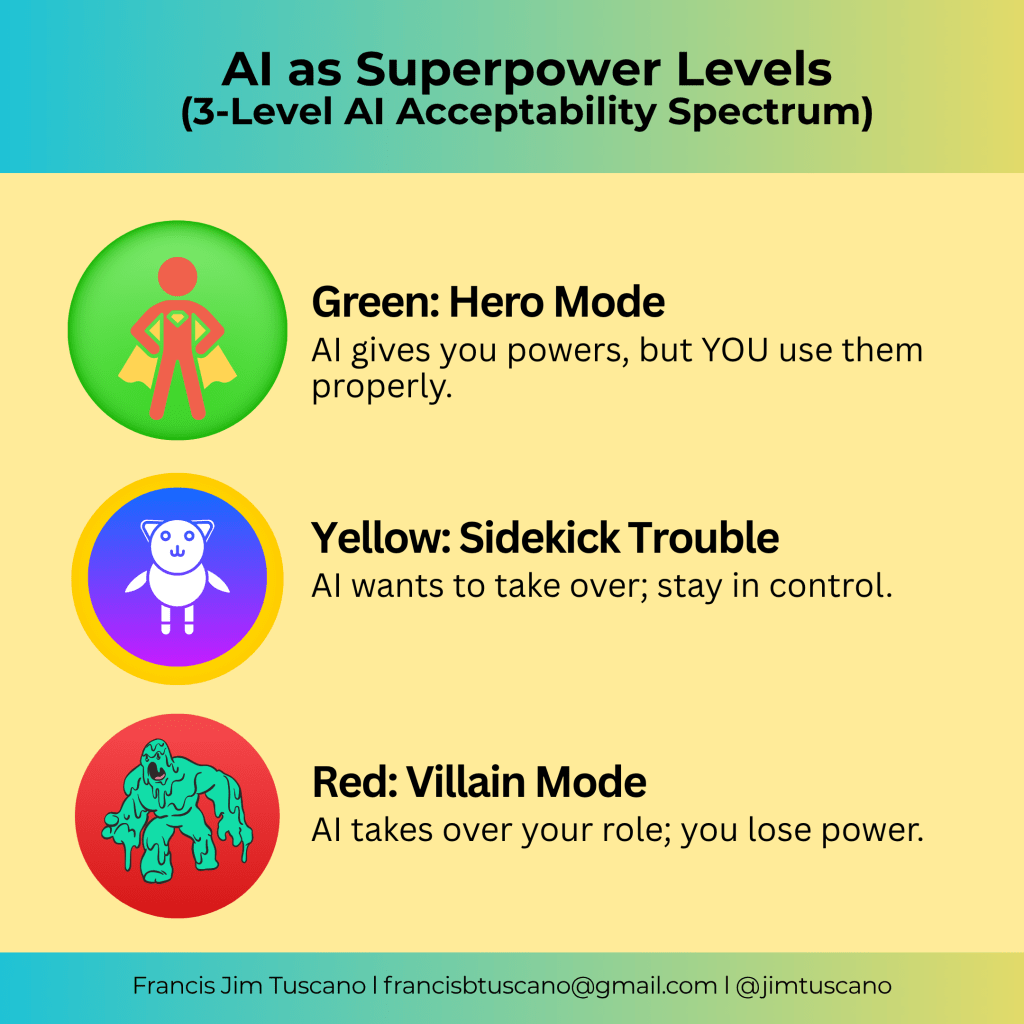

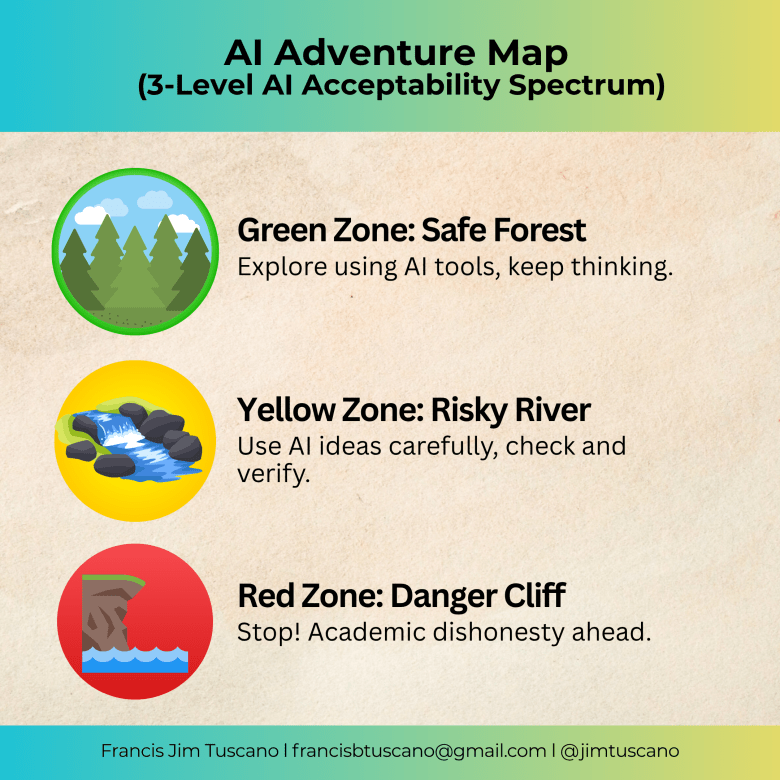
These creative tools open the door to meaningful conversations about ethics, responsibility, and the value of doing the work ourselves.
AI in education should be thoughtfully designed, ethically guided, and developmentally aligned. With the right structures in place, AI can enhance—not replace—the student learning experience.
 Francis Jim Tuscano