Today, it has become common to hear the reassuring phrase: “Teachers are irreplaceable.” But while that statement sounds noble and comforting, it must also be confronted with honesty. The hard truth is that not all teachers live up to the kind of teaching students actually need. Some merely deliver content, check compliance, and move on. And when that’s all a teacher does, AI can often do it faster, more accurately, and on demand.
In fact, during a recent interview I had with senior high school students, several of them shared how they use ChatGPT not to cheat, but to meet the needs their teachers struggle to fulfill. “I use AI to give me feedback ASAP,” one student said. “Our teacher takes too long to return our essays, and I want to improve now.” Others use AI to get clarity when teachers are unavailable or too rushed to assist. These aren’t acts of rebellion; they are reflections of unmet needs.
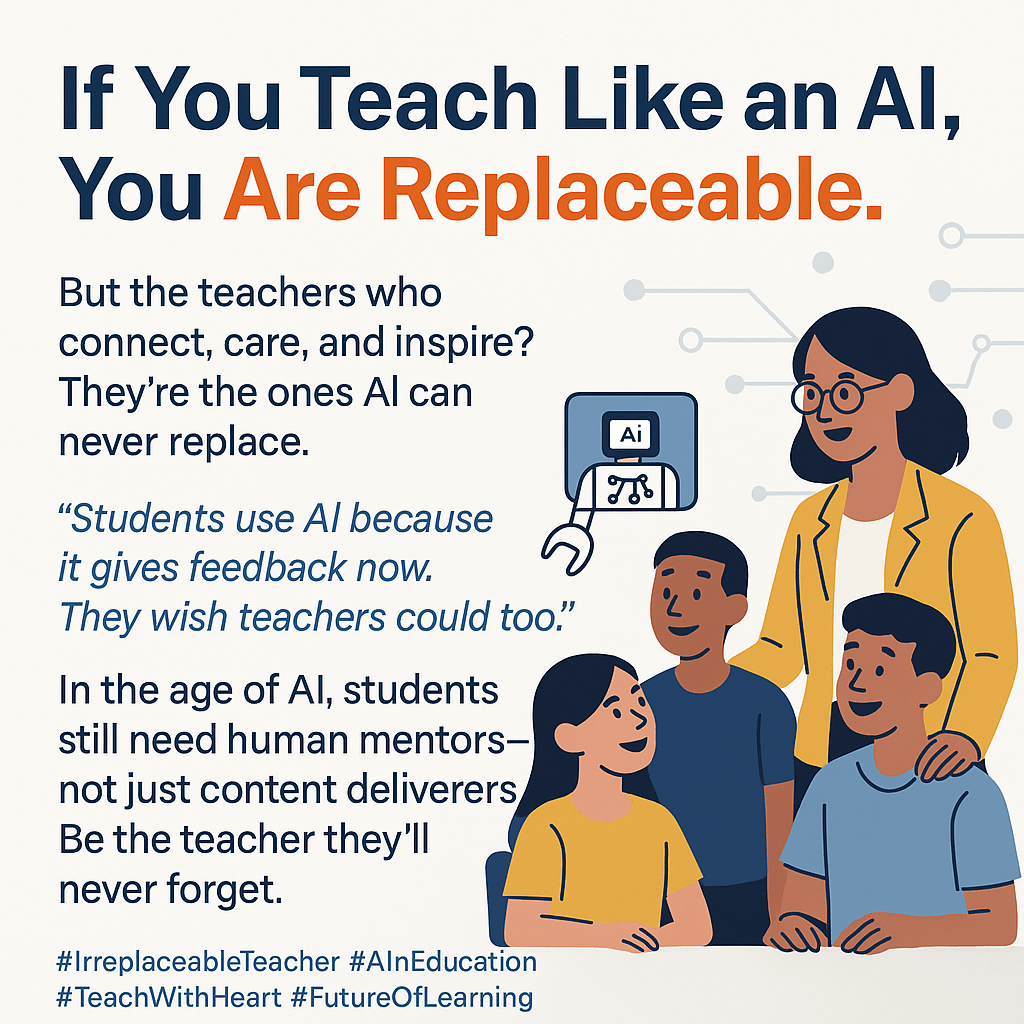
And the sobering reality is this: If you teach like an AI—mechanically, impersonally, and predictably—then you are replaceable. So what kind of teachers will always be needed, no matter how advanced AI becomes?
Students need teachers who connect. AI can simulate empathy, but it cannot truly care. It can generate praise, but it cannot make a student feel seen. The teacher who notices when a student is struggling silently, who celebrates small wins, who listens deeply—this teacher offers something no algorithm can replicate: human presence and emotional intelligence.
Students need teachers who spark curiosity. AI can give you the answer. Great teachers make you fall in love with the question. They don’t just deliver facts; they cultivate wonder. They design learning experiences that make students want to explore, to ask more, to go beyond the minimum. AI can explain, but it cannot inspire.
Students need teachers who model integrity. In a world of deepfakes, disinformation, and moral gray areas, students need to see what it looks like to lead with values. AI has no conscience, but teachers do. The best ones don’t just teach lessons—they model how to live wisely and ethically in a complex world.
Students need teachers who adapt with purpose. The irreplaceable teacher is not one who competes with AI, but one who co-evolves with it. These teachers leverage technology to improve learning—but never lose sight of the human mission of education: forming compassionate, critical, and creative individuals. They don’t fear becoming obsolete because they are too focused on being transformational.
In the age of AI, we shouldn’t just ask, “Can teachers be replaced?” We must ask, “Are we teaching in ways that make us essential?” If all we do is what AI can do—deliver slides, grade mechanically, give surface-level feedback—then yes, we risk becoming redundant. But if we teach with heart, purpose, and humanity, we become the very thing AI cannot be.
Because in the end, students don’t just need information. They need mentors. They need role models. They need hope. And that is something only a truly human teacher can give.
 Francis Jim Tuscano