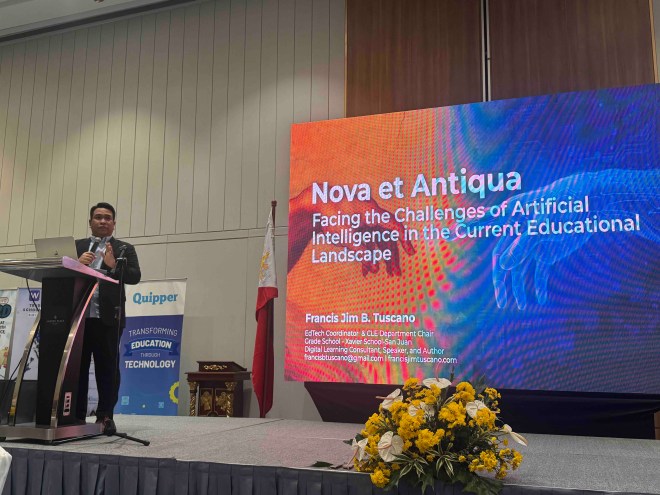
Disclaimer: Today is the feast day of St. Carlo Acutis. I want to share the plenary address, “Facing the Challenges of Artificial Intelligence in the Current Educational Landscape, ” that I delivered during during the 2025 Superintendents’ Conference of the Catholic Educational Association of the Philippines (CEAP), where I referred to the St. Carlo Acutis as a model for the young as they navigate the world of AI. Shoutout to Fr. Ari Dy, my former president at Xavier School, whose guidance and wisdom has inspired me to continue being of service to the Catholic Education in the Philippines.
Introduction
There is a reason Catholic education continues to thrive despite today’s many challenges. It is not because we have more resources. It is not because we move faster than others. It is because we draw from something deeper: a shared mission to form persons in freedom, in truth, and in Christ. But today, we are called to do this formation in an environment that is evolving rapidly. Artificial intelligence is no longer a distant possibility. It is shaping how students write, how teachers plan, how administrators decide. It challenges us not just technically, but theologically, pedagogically, and morally.
This is why the theme of this year’s SupCon, “Hope in Synodality,” is so timely. In a world being reshaped by AI, the Church calls us to journey together. We are not called to compete with machines, but to lead with wisdom, rooted in our faith, our values, and our deep belief in the dignity of every person. Let us explore how Catholic education can face AI not with fear or passivity, but with clarity, courage, and conscience.
Part I: Teaching the Human Person at the Center
Let us begin with what is at stake: “What does it mean to teach, to form, in the time of AI?”AI systems like ChatGPT may sound intelligent, but they are stochastic, which means that they generate outputs based on probability, not understanding. They are not truly intelligent; they are pattern predictors. That means they work based on data, not dialogue; prompts, not presence.This is why Antiqua et Nova, Pope Francis’ 2024 document on AI, makes a bold but necessary claim: “Human intelligence is relational, embodied, and spiritual.”
AI can simulate language. It can mimic tone. But it cannot form souls. It cannot teach love, sacrifice, mercy, or wonder. That is your vocation. That is our mission. In Catholic education, teaching is not just a transmission of content. It is a sacred encounter between teacher and student, between heart and mind, between truth and freedom. AI may become a tool in the process. But formation must remain human.
Part II: Catholic Leadership that is Prophetic, Pastoral, and Practical
If teaching remains human, then educational leadership must remain prophetic. We are called to be more than tech adopters. We are called to read the signs of the times and respond with hope and formation. There are three ways Catholic educational leaders must lead in the AI age:
1. Prophetic – We must name what others will not. When AI becomes a tool of dehumanization, we must speak. When algorithms reproduce bias, we must challenge. When digital trends compromise dignity, we must hold the line.
2. Pastoral – AI is raising anxiety in our schools. Students worry about relevance. Teachers fear replacement. Parents feel confused. Catholic leadership must offer accompaniment, not just answers; presence, not just policies.
3. Practical – Hope is not an idea. It is action. We must train our teachers. Design new curricula. Guide student use. Support parents. Engage vendors with ethics. Evaluate tools with mission in mind.If we believe AI is shaping education, and it is, then we must not leave formation to chance. We must lead with conscience, structure, and faith.
Part III: From Caution to Formation (and the Question of Sustainability)
This is where policy comes in, not as control, but as formation at scale. Enter the MaPSA AI Integration Framework and Policy Guidelines, whose development I facilitated along with MaPSA AI Technical Working Group. This is not just a compliance document. It is a moral and missional response to the digital age. It moves us beyond fear-based bans and toward thoughtful, Gospel-rooted integration. At its core is a mission statement: “Gospel-rooted, ethically guided, and educationally sound integration of artificial intelligence across MaPSA schools.”Three Pillars, One Mission:
1. Catholic Theological and Ethical Foundations: AI must serve the human person, protect truth and justice, and never reduce students to data points.
2. Ethical Oversight and Formation Mechanisms: Structures for vetting, grievance, and ongoing digital ethics formation for teachers, students, and leaders.
3. Whole-School Operational Structure: AI integration across teaching, student services, governance, and leadership, so it doesn’t stay siloed.
This framework ensures that we lead not just with efficiency, but with meaning. Not just with innovation, but with mission. And it goes one step further into ecological stewardship. Too often, AI is framed as invisible, instant, immaterial, magical. But it’s not. Every AI-generated output carries a hidden cost: High electricity usage, Water consumption for data center cooling, E-waste and digital pollution.
Antiqua et Nova warns us not just of AI’s social risks, but its ecological impact. As Catholic educators, we must raise awareness, implement green procurement, and consider carbon offsets in our tech use. The cloud has a footprint. And our students will inherit both the promise and the burden of that footprint. We must not pass on a digital divide and an ecological debt. This is why Catholic educational policy today must be more than rule-making. It must be sacramental formation, ethical resistance, and creation care.
Part IV: Inspiration from a Saint in Sneakers and a Keyboard
If policy gives us structure, and sustainability gives us responsibility, witness gives us hope.Let us end with one such witness: St. Carlo Acutis. The first millennial on the path to sainthood. A teenager. A coder. A child of the Church. Carlo used technology not for vanity but for evangelization. He built a global digital exhibit of Eucharistic miracles that still inspires people today. His motto: “The Eucharist is my highway to heaven.” More than his tech skills, it was how he used them that mattered. His life reminds us that the real question is not if students will use technology. It is how they are formed to use it well.
Catholic education must not settle for protecting students from harm. We are called to form digital saints: Students who code for justice, post with purpose, and think critically in faith.Pope Leo XIV has warned that it is hard to find God in AI. But in the life of Carlo Acutis, we are reminded: God can be found in the digital world, when the person behind the screen seeks Christ above all.
Final Words: Building Intelligent Hearts
AI will continue to evolve. Tools will become smarter. Systems will become faster. But no machine can replace a teacher’s integrity, a principal’s faith, a school’s mission, or a student’s soul. Let us be Catholic leaders who do not just adopt tools, but live the mission. Let us write policies that do not restrict innovation, but protect human dignity. Let us form students who are not only digitally literate, but spiritually wise.
Because in a world full of intelligent machines, may we be remembered as educators who built intelligent hearts.
—–
AI Declaration: I used ChatGPT for idea exploration and Apple Intelligence for grammatical improvements.
 Francis Jim Tuscano