We live in a time that celebrates speed. Faster internet, faster delivery, faster communication, and faster success have become defining characteristics of modern life. Artificial Intelligence fits naturally into this environment because it promises answers, content, and solutions within seconds. It aligns with a society that increasingly values efficiency and convenience. The deeper question, however, is not simply what AI can do, but what we may be sacrificing in exchange for speed.
In Filipino, the word “mabilisan” captures this reality well. It refers to something done quickly and efficiently, often without sufficient reflection or depth. Technology might have helped create the culture of mabilisan. It most certainly accelerated it.
The Pattern of “Fast” in Society
Our history shows that whenever speed becomes a dominant value, unintended consequences often follow. Many innovations begin by solving a real problem, yet over time they create new challenges that society must confront. This pattern appears across different aspects of everyday life.
Fast food was introduced to save time and provide convenient meals. While it solved the problem of accessibility and speed, decades later many societies struggle with chronic health conditions linked to unhealthy dietary habits. What began as convenience eventually became a public health concern.
Financial systems reveal a similar trend. Online lending platforms promise fast loans with minimal requirements. Yet many borrowers later face harassment, intimidation, or overwhelming debt when repayment becomes difficult. The pursuit of fast money follows the same logic. Networking schemes and pyramid structures promise rapid financial success. However, many participants eventually discover that these systems are unsustainable and often exploit those who join later.
Even relationships have been influenced by the culture of speed. Digital platforms make it easy to connect with people instantly. Yet the same speed can also produce shallow interactions and emotional burnout. Education is not immune to this pattern. Students frequently resort to cramming information before examinations. While this strategy may produce short term results, the knowledge is often forgotten soon after.
Consumer behavior reflects the same dynamic. Digital wallets and one click purchasing remove the friction from buying decisions. However, this convenience can easily lead to impulsive spending and financial stress. Across these examples the pattern is consistent. Speed solves an immediate problem but often introduces deeper consequences that appear only later.
AI Enters the Culture of Speed
Artificial Intelligence now enters this cultural landscape shaped by convenience and acceleration. AI can write essays, summarize research, generate lesson plans, and produce creative content within seconds. For many professionals this capability promises unprecedented productivity. However the central question remains the same: ano ang kapalit? If answers can be generated instantly, will people still take the time to think deeply about problems? If information becomes effortless to produce, will learners still engage in the intellectual work required to understand it?
The Risk of Cognitive Fast Food
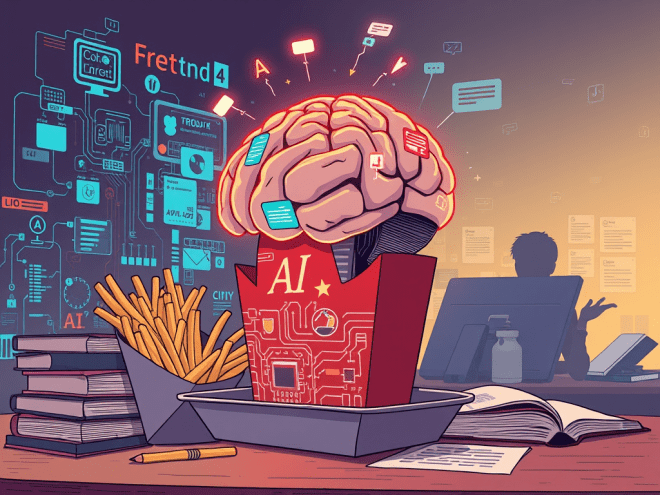
One of the most important risks in the age of AI can be described as cognitive fast food. AI can easily become the fast food of thinking. It satisfies the need for quick answers but may not develop intellectual strength. Fast food fills the stomach quickly but does not always provide what the body needs for long term health. In the same way AI generated responses can fill documents with information without necessarily strengthening the mind.
A student may produce an essay within minutes. A researcher may generate a summary of complex literature without reading the original sources. A teacher may design a lesson plan almost instantly. However producing output is not the same as developing understanding. Real thinking requires friction. Real learning requires struggle. Real creativity requires time. When AI removes all friction it may unintentionally weaken the very skills education is meant to cultivate. Critical thinking, discernment, reflection, and originality grow through effort and engagement. These abilities cannot be developed through instant answers alone.
The Responsibility of Education
The challenge therefore is not artificial intelligence itself. AI is a powerful tool that can assist human work and expand our capabilities. The real danger lies in the mindset that assumes knowledge should always be produced instantly. Education has never been primarily about speed. Its deeper purpose is formation. Schools are meant to develop habits of mind, intellectual discipline, and the ability to engage with complex ideas.
AI will continue to evolve and its capabilities will expand rapidly. Schools cannot simply reject these technologies nor should they embrace them without careful reflection. Instead educators must guide students toward a wiser relationship with technology. AI can assist thinking but it must not replace thinking. AI can accelerate tasks but it must not eliminate reflection. In many cases the most meaningful intellectual growth occurs when there is no shortcut.
Choosing Wisdom Over Speed
The challenge of AI is not only technological but cultural. Society must learn to distinguish between areas where speed is beneficial and areas where patience is essential. Communication and logistics benefit greatly from technological acceleration. However moral judgment, deep learning, creativity, and character formation cannot be rushed. These dimensions of human development require time and reflection.
If the culture of mabilisan dominates every aspect of life society may produce faster outputs but weaker thinkers. The goal should therefore not be to slow down technology but to cultivate wisdom in how it is used. AI presents humanity with both an opportunity and a test. It forces us to ask a fundamental question about the future we want to build.
Do we want a world that is merely faster? Or do we want a world that is wiser?
 Francis Jim Tuscano