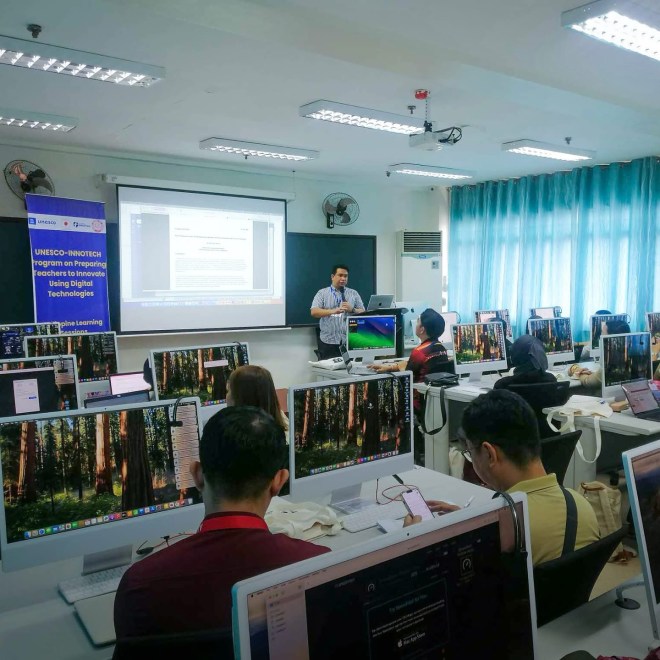
After my lecture and workshop series at West Visayas State University, I had the privilege of engaging in a delightful and thought-provoking conversation with Dr. Tin, the lovely and cheerful Vice President for Academic Affairs. In our discussion, while I was waiting for the van that would take me to the local airport, I posed a question that had been weighing on my mind: What if we no longer know what makes us irreplaceable as teachers? It’s a hard question to ask, but do we really take the time to reflect on it? Have we spent so much time adapting to technological shifts that we have failed to define, in clear and meaningful terms, what lies at the heart of our profession?
Dr. Tin paused, recognizing the weight of the question. Then, she asked if she could use it in her course on the Teaching Profession. Her response reaffirmed for me that this is a question we must confront—not just individually but as a community of educators. If we do not actively engage with it, we risk passively surrendering to an educational landscape where the role of the teacher is shaped more by technological efficiency than by human connection.
For years, the integration of technology in education has reshaped the classroom experience. AI now offers automated grading, personalized learning pathways, and even lesson planning assistance. While these developments promise efficiency, they also challenge the teacher’s role. Some might argue that if AI can generate lesson plans, assess student work, and even answer questions in real-time, then what remains for the teacher to do? This question is unsettling because it forces us to confront an existential challenge: What is it that we do that AI can never replicate?
If we define teaching merely as the transmission of knowledge or the management of learning, then AI is indeed poised to take over many traditional responsibilities. However, teaching has always been more than the delivery of information. It is about connection, inspiration, and the development of human potential. A great teacher does not just explain concepts; they ignite curiosity, cultivate resilience, and nurture moral and ethical reasoning. They recognize the unspoken struggles of students, celebrate their unique strengths, and provide mentorship that extends far beyond the classroom. AI, no matter how advanced, cannot replace the deeply human aspects of teaching—empathy, intuition, and the ability to inspire.
However, the danger is that in our rush to integrate AI into education, we may slowly forget or devalue these very aspects of teaching. If the role of the teacher is increasingly framed in terms of managing AI tools, adapting to technology-driven systems, and optimizing student performance metrics, we risk losing sight of our true purpose. The teacher may become more of an AI facilitator than a human guide, and more of a content curator than a mentor. If we are not careful, we may reach a point where we struggle to define what makes us irreplaceable—not because we have been replaced, but because we have unconsciously allowed our essence to erode.
The challenge, then, is not simply to resist AI but to actively reaffirm what makes teachers indispensable. This means embracing AI as a tool while safeguarding the human elements of teaching. It means ensuring that while AI personalizes learning, teachers remain the architects of meaningful learning experiences. It means that while AI can provide instant feedback, teachers remain the ones who nurture growth through thoughtful conversations and authentic relationships. Above all, it means that education must not become a sterile transaction of knowledge, but remain a deeply human endeavor of formation, transformation, and purpose.
At this point, the question is not whether teachers will be replaced, but whether we will remember—and fight for—what makes us irreplaceable. If we do not, we may wake up one day to find that the essence of teaching has not been taken from us, but lost by our own neglect. Now, more than ever, we must reclaim and articulate what it truly means to be a teacher.
 Francis Jim Tuscano