
The integration of AI into teaching must be intentional and developmentally appropriate, ensuring that students continue to build critical thinking, creativity, digital literacy, and ethical reasoning alongside AI support.
For AI to be an effective learning tool, its use must align with established learning competencies and cognitive development. Students should engage with AI in ways that deepen understanding rather than promote dependency. This means that while AI can assist with information retrieval, content generation, and analysis, educators must design activities where learners actively process, critique, and apply knowledge themselves.
Additionally, when incorporating AI tools in learning, teachers must ensure that these tools comply with data privacy regulations, institutional policies, and ethical AI practices to protect student information and maintain responsible AI use in education.
For teachers new to using AI in the classroom, I made a list that provides examples of how AI tools like ChatGPT can support each level of Bloom’s Revised Taxonomy while ensuring that students develop essential human skills.
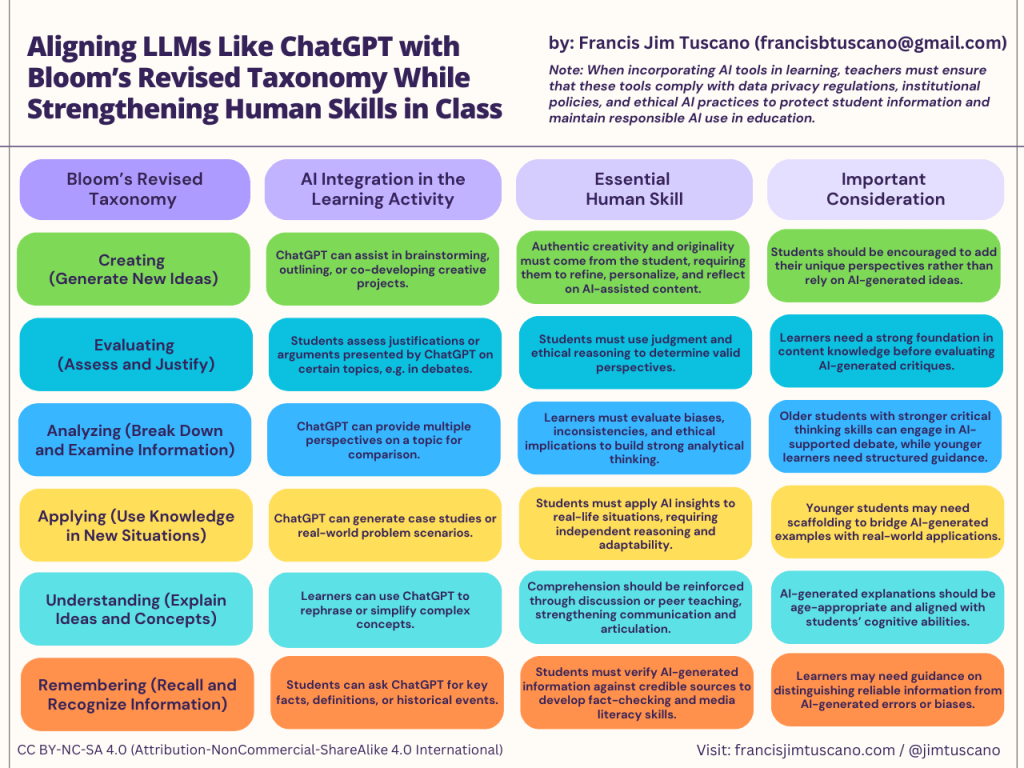
1. Remembering (Recall and Recognize Information)
AI Activity: Students can ask ChatGPT for key facts, definitions, or historical events.
Human Skill: Students must verify AI-generated information against credible sources to develop fact-checking and media literacy skills.
Consideration: Younger learners may need guidance on distinguishing reliable information from AI-generated errors or biases.
2. Understanding (Explain Ideas and Concepts)
AI Activity: Learners can use ChatGPT to rephrase or simplify complex concepts.
Human Skill: Comprehension should be reinforced through discussion or peer teaching, strengthening communication and articulation.
Consideration: AI-generated explanations should be age-appropriate and aligned with students’ cognitive abilities.
3. Applying (Use Knowledge in New Situations)
AI Activity: AI can generate case studies or real-world problem scenarios.
Human Skill: Students must apply AI insights to real-life situations, requiring independent reasoning and adaptability.
Consideration: Younger students may need scaffolding to bridge AI-generated examples with real-world applications.
4. Analyzing (Break Down and Examine Information)
AI Activity: AI can provide multiple perspectives on a topic for comparison.
Human Skill: Learners must evaluate biases, inconsistencies, and ethical implications to build strong analytical thinking.
Consideration: Older students with stronger critical thinking skills can engage in AI-supported debate, while younger learners may need structured guidance.
5. Evaluating (Assess and Justify)
AI Activity: AI can generate critiques or assess different arguments.
Human Skill: Students must use judgment and ethical reasoning to determine valid perspectives.
Consideration: Learners need a strong foundation in content knowledge before evaluating AI-generated critiques.
6. Creating (Generate New Ideas)
AI Activity: ChatGPT can assist in brainstorming, outlining, or co-developing creative projects.
Human Skill: Authentic creativity and originality must come from the student, requiring them to refine, personalize, and reflect on AI-assisted content.
Consideration: Younger students should be encouraged to add their unique perspectives rather than rely on AI-generated ideas.
Balancing AI and Human Thinking
AI is a valuable learning companion but should be used in ways that support competency-based education. Educators must ensure that AI tools enhance, rather than replace, independent thinking, ethical decision-making, and creativity. By designing AI-supported activities that align with Bloom’s Revised Taxonomy, teachers can maximize learning potential while ensuring students build essential cognitive and digital skills. Furthermore, responsible AI use requires educators to ensure that AI tools comply with data privacy regulations, institutional policies, and ethical AI practices, safeguarding student information and fostering a secure learning environment.

