
Over the past year, I’ve had the privilege of working with schools, education networks, and national organizations to develop AI integration policies, design professional learning programs, and help education communities navigate what it means to bring AI meaningfully into the classroom. In that work, I’ve heard the same concerns echoed again and again—from teachers, principals, and system leaders alike: Where do we draw the line? How do we ensure AI supports, rather than replaces, teachers?
It’s clear we don’t just need more tools. We need clarity—a framework that empowers educators to make thoughtful, values-aligned decisions about how and when to work with AI.
That’s why I created the Teacher–AI Collaboration Matrix.
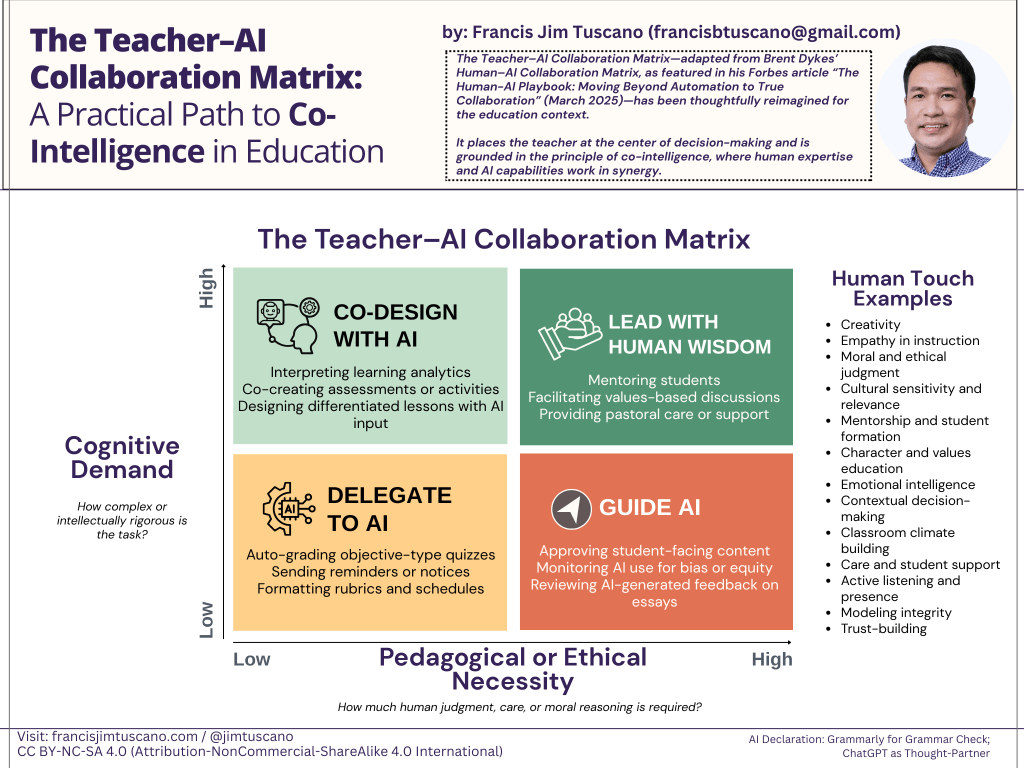
This framework, adapted from Brent Dykes’ Human–AI Collaboration Matrix (as featured in his Forbes article “The Human-AI Playbook: Moving Beyond Automation to True Collaboration”), is reimagined for the education landscape. It centers the teacher—not the tool—and is grounded in the principle of co-intelligence: the idea that humans and AI, working in synergy, can accomplish more than either could alone.
Understanding the Matrix
The matrix is structured around two key dimensions:
- Cognitive Demand – How complex or intellectually rigorous is the task?
- Pedagogical or Ethical Necessity – How much human judgment, care, or moral reasoning is required?
Together, these dimensions generate four zones of collaboration, each of which highlights a different teacher-AI relationship.
Co-Design with AI (High Cognitive | Low Ethical)
Tasks like interpreting learning analytics, co-creating assessments, or designing differentiated lessons thrive on collaboration. AI assists, but the teacher shapes the outcome. This is where co-intelligence shines.
Delegate to AI (Low Cognitive | Low Ethical)
Routine tasks like auto-grading, sending reminders, or formatting schedules can be confidently handled by AI. AI takes the lead, while teachers reclaim time for meaningful work.
Guide AI (Low Cognitive | High Ethical)
Even simple tasks—like reviewing AI-generated feedback—require teacher oversight for appropriateness, fairness, and context. Teachers supervise, making judgment calls that AI cannot.
Lead with Human Wisdom (High Cognitive | High Ethical)
Mentoring students, facilitating values-based discussions, or offering pastoral care are deeply human tasks. AI steps aside here. The teacher leads with empathy, presence, and discernment.
Human Touch Examples
These uniquely human capacities guide when the teacher must lead:
- Creativity
- Empathy in instruction
- Moral and ethical judgment
- Cultural sensitivity and relevance
- Mentorship and student formation
- Character and values education
- Emotional intelligence
- Contextual decision-making
- Classroom climate building
- Care and student support
- Active listening and presence
- Modeling integrity
- Trust-building
Why This Matters
The Teacher–AI Collaboration Matrix gives teachers and school leaders the structure they need to practice co-intelligence with confidence. It affirms that AI has a place in the classroom—but not every place.
As we continue to design tools like GabAI and build AI literacy among Filipino educators, this matrix serves as a roadmap. It helps us remember that the goal isn’t automation—it’s amplification. Not replacement—but reflection. Not less humanity in learning—but more.
Because no matter how far AI evolves, the heart of the classroom remains human.
 Francis Jim Tuscano
One thought on “Teachers and AI Can Thrive Together—If We Get the Collaboration Right”
Comments are closed.